Saturday, 28 March 2020

Bee Gyroplane

CKE recently posted the photo below on Facebook - thanks for that Bruce.  It is of the Bee Gyroplane as I remember it from the mid 1960s when it was demonstrated at Wellington Airport.  I seem to remember that it was painted blue at that time. 

Miss Beverley Cook, a teller at the Otahuhu A.N.Z. Bank, poses ... in an Australian built Bee gyroplane which was on display at the bank last week. The craft, the only one of its kind in New Zealand, was loaned to the bank by Mr C.B. Malloy of Auckland in conjunction with the Bee Aircraft Sales (New Zealand) Limited ... It is possible for a person with suitable aptitude to learn to fly the Bee gyroplane in six hours having no previous flight experience. The plane is capable of a conservative maximum speed of 75 m.p.h. Its normal cruising speed is 50 m.p.h. Minimum level flight speed is 10 m.p.h. and land speed only seven m.p.h. The machine is capable of landing in a distance of seven yards. Its normal take-off is a run of about 100 yards, but it is capable of taking off in a distance of 30 yards with the rotor spin up. The gyroplane has a range of about 150 miles and empty weighs 225 pounds ... It is capable of climbing at 950 feet a minute. The petrol tank holds 13 gallons. The propulsion is provided by a modified McCulloch flat four two-stroke engine of 72 b.h.p. driving a fixed pitch propellor ... " (South Auckland Courier, 23 September 1964, p. 30)."
Auckland Libraries Heritage Collections Footprints 06727
ZK-HAS (c/n 0001) was the second gyroplane to be registered in New Zealand, after Trevor Laugeson's ill fated Benson-Laugeson 7MC Gyro ZK-HAM which crashed at Paraparaumu in April 1963 killing him.

Later the Department of Civil Aviation created the ZK-R block of registrations that was to be reserved for rotorcraft and ZK-HAS was re-registered as ZK-RAA in August 1974.  ZK-RAA was cancelled as Withdrawn From Use in April 1995 but was re-registered in December 1995 and remarkably it is still current, registered to Ken Olsen of Papakura.

I caught up with it at Ardmore on 21/3/09 and one could be forgiven for thinking it was not the same aeronautical device at all! 

If anyone can add anything to the history of early gyroplanes in New Zealand I would be interested to hear via comments on the blog.


Friday, 27 March 2020

I remember when -

- flying was fun.
Here we are outside the Rangitaiki Pub - from memory sometime in 1969.
I wonder where they all are now ?

I can probably account for the aircraft but alas the people ----

On the left is the Piper PA-18-95 ZK-CXC c/n 18-6202 still active out of Rangiora.

Then we have the Piper PA-22-150 Caribbean ZK-BSI c/n 22-7354 which got bent in February 1997 at Kimbolton.

In behind is the Piper PA-18A-150 ZK-CMQ c/n 18-6379 which I believe is still active with Gene Barnum out of Willow, Alaska as N555GB.

Then we see the AESL Airtourer Super 150 ZK-CZP c/n A537 which flew across the Tasman in April 1976 to become VH-COI and has been with John O'Halloran of Tewantin, Queensland ever since.

On the far right is the Cessna 185D ZK-CHS c/n 1850793 sadly lost alongside the Desert Road on 19-03-1979.

Interestingly of these - ZK-CXC was a rebuild of ZK-BTT, ZK-CMQ was a rebuild from ZK-BPL and ZK-CZP was a rebuild of Victa 115 ZK-CMA.

Tecnam P 2006T ZK-MTM at Tauranga

There were three Tecnam aircraft  imported into Tauranga in February 2020.  They were the two Tecnam P 2008s ZK-TJT and ZK-TKT that were registered to the New Zealand Airline Academy of Oamaru on 4/3/20, and that we have covered previously on this blog.

The third Tecnam was a twin engined four seater P 2006T:

Tecnam P 2006T ZK-TMT (c/n 288) was registered to the Tecnam agents Jetboat.Com Ltd of Gore on 4/3/20.  It is photo'd above outside Solo Wings on 13/3/20.  If you double click on the photo to enlarge it you can see some of the detail of the 100 HP Green Top Rotax 912S engine installation.

Thanks for the photo HMR.

ZK-TMT is the fourth P 2006 to be registered in New Zealand.  The other three were ZK-TWN2, ZK-MTW and ZK-OBZ (since exported).  You can search for these in the search box at the top left of the home screen if you need to fill in a bit of time.

Thursday, 26 March 2020

Coming along nicely.

This Australian Aviation J6 Karatoo under construction at Rangiora was out engine running on Sunday - this was the first time ruining with its spinner attached.
I am not privy to its pending registration - but ZK-KTC was bandied around when Caroline Trevella was working on it in the early stages of the build.
This will be the 4th on the register after  ZK-KTN with Nigel Forrester at Alexandra, ZK-KTO with Mike Small at Rangiora and ZK-KTP with Dave McPherson out at Oxford. 
There are a couple more Karatooz under construction.
Nice.

Question Time

A nice easy Question Time to start the 'holidays'
Just tell us what type we have - followed by a likely ZK registration ?

To help weed out the multitude of correct answers -:- 

What is written on the wing tips ?

Sadly there will be no chocolate fish this time round.

Virgin Australia Closes New Zealand Bases

Virgin Australia Airlines has announced that it is looking to close its New Zealand crew bases impacting 550 New Zealand based staff.  See HERE

Boeing 737-800 VH-YIV on late finals into Queenstown last September under gathering dark clouds.

Wednesday, 25 March 2020

Nesmith Cougar (Only One) of New Zealand

The next type of sport aircraft to be registered here was the one off (to date) Nesmith Cougar.

The Nesmith Cougar was developed by Robert Nesmith of Houston, Texas in 1957.  At that time Nesmith thought he could improve on Steve Wittman's earlier Wittman Tailwind, but in fact the two are so similar that they are very difficult to tell apart.  The Cougar was developed for a higher powered engine (the 118 HP O-235 instead of Wittman's original 85HP Tailwind)  Of course, builders have installed more powerful engines in both aircraft, and Tailwind ZK-RET currently has a 160HP O-320 engine).  The Cougar originally did not have flaps but some builders have added them.  The dimensions of the Cougar and the Tailwind are within inches of each other and they both use the same 83 square feet wing with the NACA 4309 airfoil.  Take your pick!

The Cougar's length is 18 feet 11 inches (5.77 metres) and wingspan is 20 feet 6 inches (6.25 metres).  Empty wieght is around 624 pounds (283 Kg) and MAUW is 1,250,pounds (567 Kg).  And with an O-235 engine the top speed is listed as 195 mph.

ZK-CNA2 (c/n RD 1) was first registered on 22/11/11 as a Class 2 microlight to Rodney J Davis of Blenheim, and it is photo'd above at Omaka on 26/2/15 with Rod Davis at the controls.  The registration ZK-CNA refers back to the first ZK-CNA which was a Piper Pawnee that Rod Davis flew as an ag pilot for Aerial Work (Marlborough) in the 1970s.  ZK-CNA2 has an O-235 engine and was built over a period of around 20 years, with its first flight carried out by Jerry Chisum on 24 July 2013.  Rod Davis also previously built Thorp T 18 ZK-ROD.

On 2/5/15 the aircraft was sold to Peter J Locke of Hokitika and then recently, on 16/1/20 it was sold to P J Gotlieb of Foxton Beach.  It is photo's above after delivery to Foxpine on 16/1/20.


All Private and Recreational Flying in New Zealand to Cease from Today 25-3-2020

Due to the Covid 19 pandemic and the elevation to Level 4 tonight, the CAA has advised that all private and recreational flying in New Zealand is required to cease from this afternoon 25 March 2020.

We will still post on the NZ Civair blog but our posts will be historical.

To all our followers Keep Safe.


Tuesday, 24 March 2020

Sikorsky EH 60A Blackhawk ZK-HKU

Kahu New Zealand Ltd's Sikorsky EH 60A Blackhawk arrived at Auckland in June 2019 registered as N160PA and it initially operated here under its American registration.  It was registered ZK-HKU3 on 13/1/20.

This month it flew down to Queenstown for a job and Tim Gorman photo'd it going there and back:

Parked up at Milson Airport on 23/3/20.

It looks grunty even when it is parked!

Because of the covers over the engines what the top 2 photos don't show is the company name on the fuselage, and this is shown in the above photo which Tim took as the Blackhawk headed South past Manakau to Queenstown earlier in the month.

Thanks for the use of the photos Tim.

Monday, 23 March 2020

Homegrown Two Seat Homebuilt Aircraft of New Zealand (11) - Jodel D 150X Governor

I will continue and finish my series on Homebuilt and Sport Aircraft of NZ as I will have time over the next few weeks....  So here is the next type of sport aircraft to be registered in New Zealand:

Charlie Kenny of Clydevale near Balclutha is a true blue Jodel enthusiast and he previously built a Jodel D 9 (ZK-AKR The Clydevale Phantom).

But Charlie reckoned he could build a better Jodel so he came up with his D 150X Governor  ZK-CCD2 (c/n AACA 360/2) in which he incorporated what he reckoned were the best bits of all the many Jodel models.  So Charlie's D 150X has the rudder from the D 150, the all flying tailplane from the D 18 (but bigger), the luggage locker from a D 140 and the wing airfoil is that of a D 18 but again applied to a bigger wing.  The wing has split flaps that drop down from the trailing edge.  Charlie has also made the fuselage wider than the D 150 at 44 inches while he has moved the seat back 3 inches and sloped the seat to 30 degrees which gives a very roomy cockpit.  The windscreen is from a Fletcher FU 24 and it has really neat gull wing doors.

But that is not all that makes Charlie's Jodel unique, because it is powered by a 1.9 litre Peugeot turbo diesel engine (from a Peugeot 405) that produces around 100 HP.  It has a belt reduction drive designed by Wayne Affleck of Invercargill that gives 2400 rpm at the propellor for 3300 rpm engine revs.  The engine is water cooled and the radiator in located in the starboard wing root with the battery located in the port wing root.  Charlie developed the engine himself but later found out that Jean Delemontez (the del in Jodel) and Jacques Vion had developed their Delvion diesel engine along very similar lines.  The diesel engine is very economical using only around 10 litres per hour at cruise.

The dimensions of Charlie's D 150X Governor are similar to the D 150 Mascaret which has a length of 6.30 metres (20 feet 8 inches), a wingspan of 8.15 metres (26 feet 9 inches) and a wing area of 141 square feet.

Charlie Kenny taxyng his Jodel D 150X ZK-CCD2 at his Clydevale farm airstrip on  16/11/14.  It was first registered on 7/11/11.


A view of the large all flying tailplane.

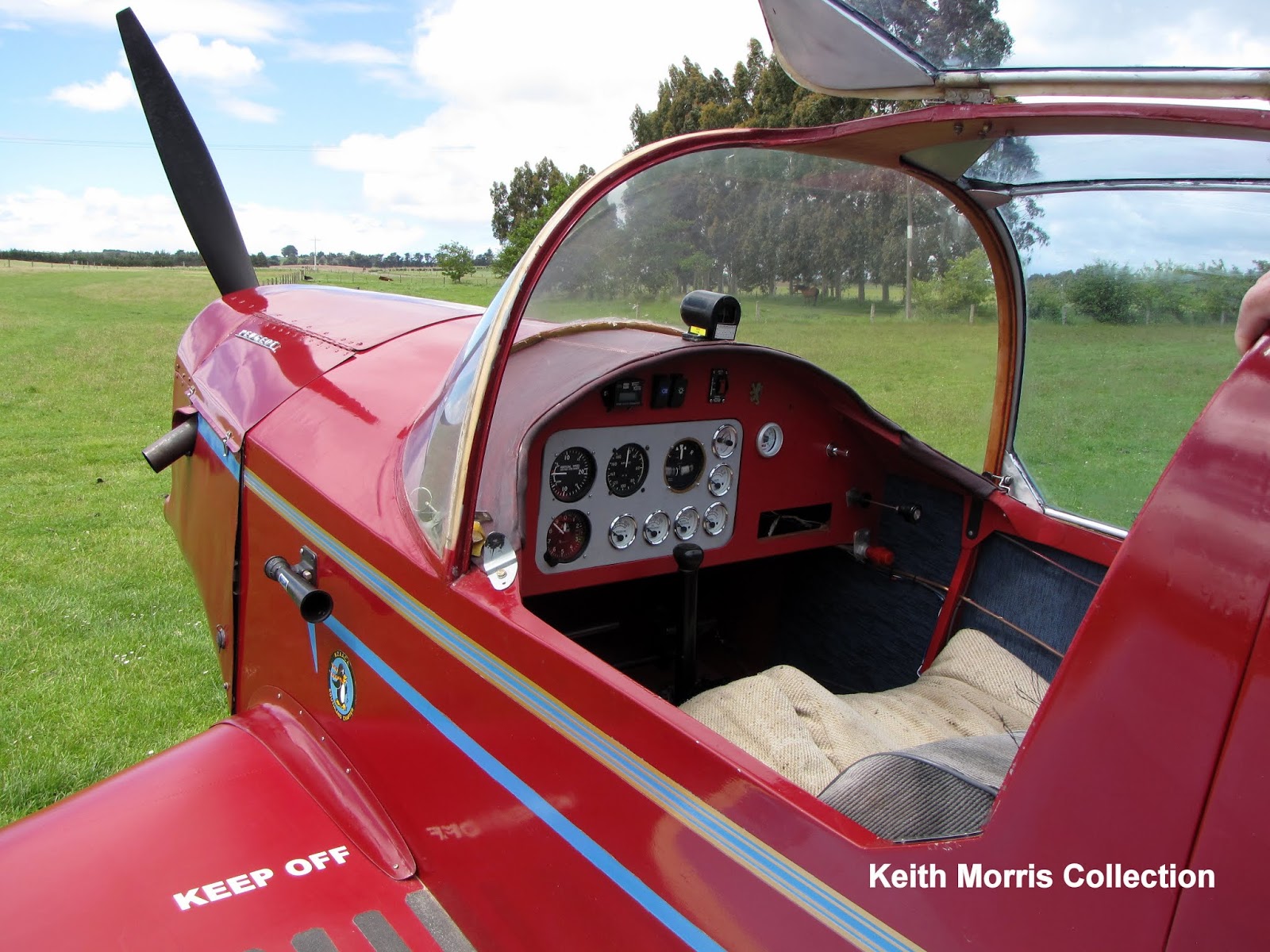
And a look inside the spacious cockpit.

The first flight was on 2 July 2015.  Charlie told me that his aircraft flies really well and he has flown about 65 hours in it to date, although it hasn't flown in the last year or so.

I reckon that Charlie Kenny has a bit of Burt Munro about him as he has designed and built his D 150X entirely by himself in his shed, as well as sorting the entirely clean sheet engine conversion and all its systems.  He has achieved a great result!